
The Only Two Real Pirate Flags That Exist — And Why That Matters
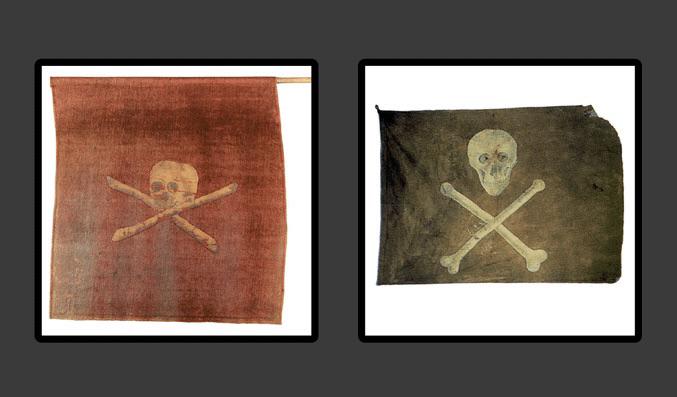
They aren’t from the Caribbean. They aren’t from Blackbeard. But they’re the real deal.
You probably think you know what a pirate flag looks like.
Skull. Crossed bones. Maybe a bleeding heart or an hourglass.
But here’s the thing: those are all stories. Symbols passed down, copied, and stylized into cliché.
In the real world, there are only two confirmed, physical pirate flags that historians have ever found. Just two. And neither of them comes from the Golden Age of Piracy you see in movies.
Let’s look at what we actually know.
Flag #1: The Royal Navy’s Trophy
This flag was seized off the North African coast around 1780, during a battle with Barbary corsairs. It’s a deep, blood-red banner — faded and torn, but still striking.
It now rests in the National Museum of the Royal Navy in Portsmouth, England.
What’s amazing is that the color has survived. Cloth from the 1700s usually doesn’t.
It’s likely the only reason this flag made it into a museum is because the Royal Navy captured it directly from enemy hands. That chain of custody gives it historical weight — it’s not a replica or a rumor.
Flag #2: The Åland Artifact
The second verified pirate flag sits quietly in the Åland Maritime Museum in Finland. It’s a black flag — or it used to be. Time has worn away much of its shade.
It too came from a North African corsair ship, likely in the early 1800s.
So we’ve got one red flag, one black. Both were used by Barbary corsairs, not Caribbean pirates.
That’s the twist. These aren’t tied to famous names like Blackbeard or Calico Jack. They’re from another pirate story entirely — one history mostly forgets.
The Golden Age? No Flags Survived
Ask any historian: not a single authenticated pirate flag from the Golden Age (roughly 1650–1720) has been found.
That’s wild, considering how much our pirate imagery comes from that era. The skull-and-crossbones, the hourglass, the flaming swords — they’re based on accounts, sure. But not real fabric. Not real objects.
Most of the flags we “know” are guesses. Artist interpretations. Best-case reconstructions.
Even the most iconic Jolly Rogers you’ve seen on t-shirts are based on late-stage written records or secondhand drawings.
Why Did So Few Survive?
Simple: cloth doesn’t age well, especially at sea.
Add to that the pirate lifestyle — burning evidence, hiding loot, ditching anything that could identify you — and it’s no surprise that flags weren’t exactly heirlooms.
It’s actually kind of a miracle that two survived at all.
And it makes those two all the more important.
What These Two Flags Tell Us
- History is fragile. Most of it didn’t survive the ocean. These two did.
- Authenticity is rare. When something’s real, it’s worth preserving.
- Legend ≠ Reality. Most of what we think we know about pirates is story, not fact.
My Take
I’ve always loved pirate stories. The drama, the rebellion, the weird mix of violence and mythology.
But these two real flags? They tell a different story. A quieter one.
No cinematic glamour. No dramatic speeches. Just two pieces of cloth — carried across centuries, caught by chance.
So next time you see a pirate flag in a costume shop or a Netflix show, think of these two tattered banners.
Because while most of the legend is fiction, these were real. And they’ve got the sea salt to prove it.